he Barcelona head coach occupies a seat that demands silverware, yet the true measure of success at Camp Nou extends far beyond the trophy cabinet. Xavi Hernández’s tenure illustrated this tension perfectly. When he took over in November 2021, Barcelona languished ninth in La Liga, playing without recognizable structure. Within eighteen months, his side claimed a league title by a ten-point margin. Critics still questioned his long-term viability because the football。at times, felt reactive rather than proactive. That contradiction defines the job: a Barcelona head coach must win, but winning with the wrong style buys only temporary patience.Consider the pressing scheme. Barcelona’s identity hinges on high turnovers and positional play—the juego de posición—where players occupy zones, not fixed spots. Xavi’s 2022-23 squad recovered the ball in the final third 7.2 times per match, second only to Real Madrid in La Liga. Impressive, yet the Champions League group stage exit against Inter Milan and Bayern Munich exposed a brutal truth: domestic pressing numbers mean little when European opponents bypass the first line with two passes. I watched that Inter match at Camp Nou from the third tier. The anxiety in the stands wasn’t about effort;
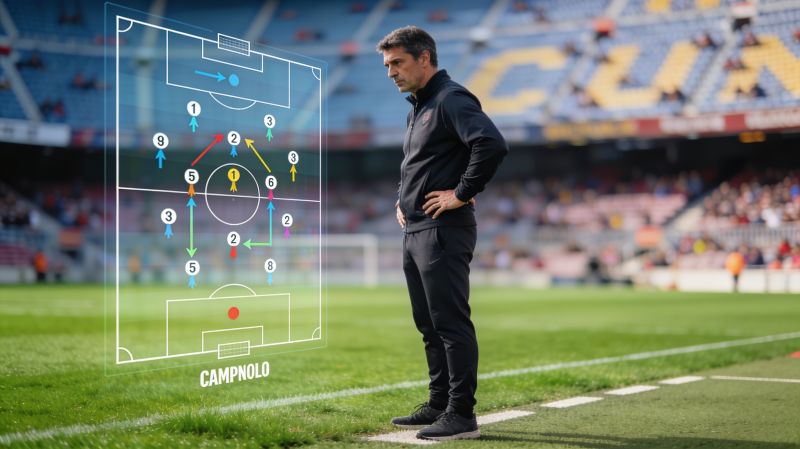
it was about recognition. Fans saw a team that couldn’t sustain its own principles under pressure. A Barcelona head coach who abandons pressing triggers during big matches loses the crowd faster than one who loses 1-0 while sticking to the plan.Hansi Flick’s appointment in May 2024 brought a different kind of scrutiny. His Bayern Munich and Germany sides relied on vertical transitions and aggressive counter-pressing, not the patient circulation Barcelona purists revere. Early training reports from the Joan Gamper complex suggested Flick drilled a 4-2-3-1 with two holding midfielders—a shape that can suffocate creativity if the No. 10 drifts too deep. One club source told me the dressing room initially struggled with the intensity of Flick’s double sessions, though veterans like Marc-André ter Stegen welcomed the shift. Flick’s first Clásico approach will reveal everything. If he sets up to absorb pressure and hit Real Madrid on the break, he risks alienating the socios. If he forces high possession against a side built to counter。he risks humiliation. The Barcelona head coach rarely gets a middle path.Financial reality complicates every tactical decision. The club’s wage bill still exceeds La Liga’s spending cap by a significant margin, forcing the Barcelona head coach to rely on La Masia graduates and low-cost signings. Lamine Yamal’s emergence as a genuine difference-maker at sixteen wasn’t part of a master plan;it was necessity. Fermín López and Marc Casadó followed similar paths. This youth dependency creates a volatile environment. A coach who demands experienced, physically dominant midfielders won’t get them. Flick must mold teenagers into Champions League contributors while managing a board that fires managers after two winless streaks. Ronald Koeman and Xavi both learned that lesson. Tactical identity, however brilliantly conceived。crumbles without squad depth.So what should Barcelona expect from Flick?
Not a carbon copy of Guardiola’s 2011 side. That football required peak Messi, Xavi, and Iniesta—generational anomalies. A more realistic target: restoring the high press as a non-negotiable habit, integrating Yamal and Pedri into a system that protects their strengths, and accepting that some defeats will look ugly. The Barcelona head coach who survives isn’t the one with the most elegant PowerPoint presentation. It’s the one who convinces the locker room that suffering without the ball is as honorable as tiki-taka. Xavi did that for eighteen months;then the message wore thin. Flick’s challenge is simpler and harder: make the players believe the press is the identity, not a tactic. If he does, trophies follow. If he doesn’t。another coach will inherit the same impossible expectations.